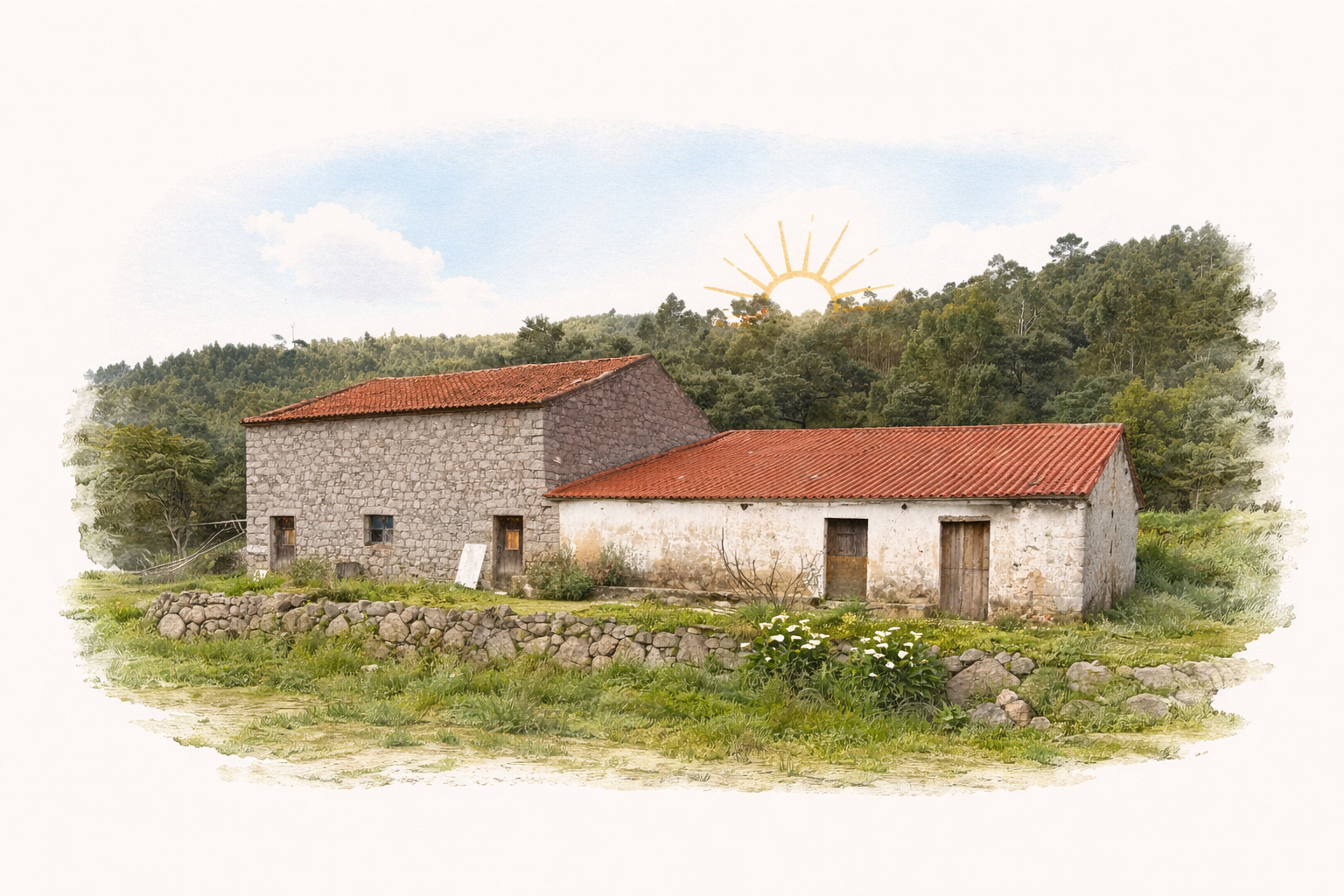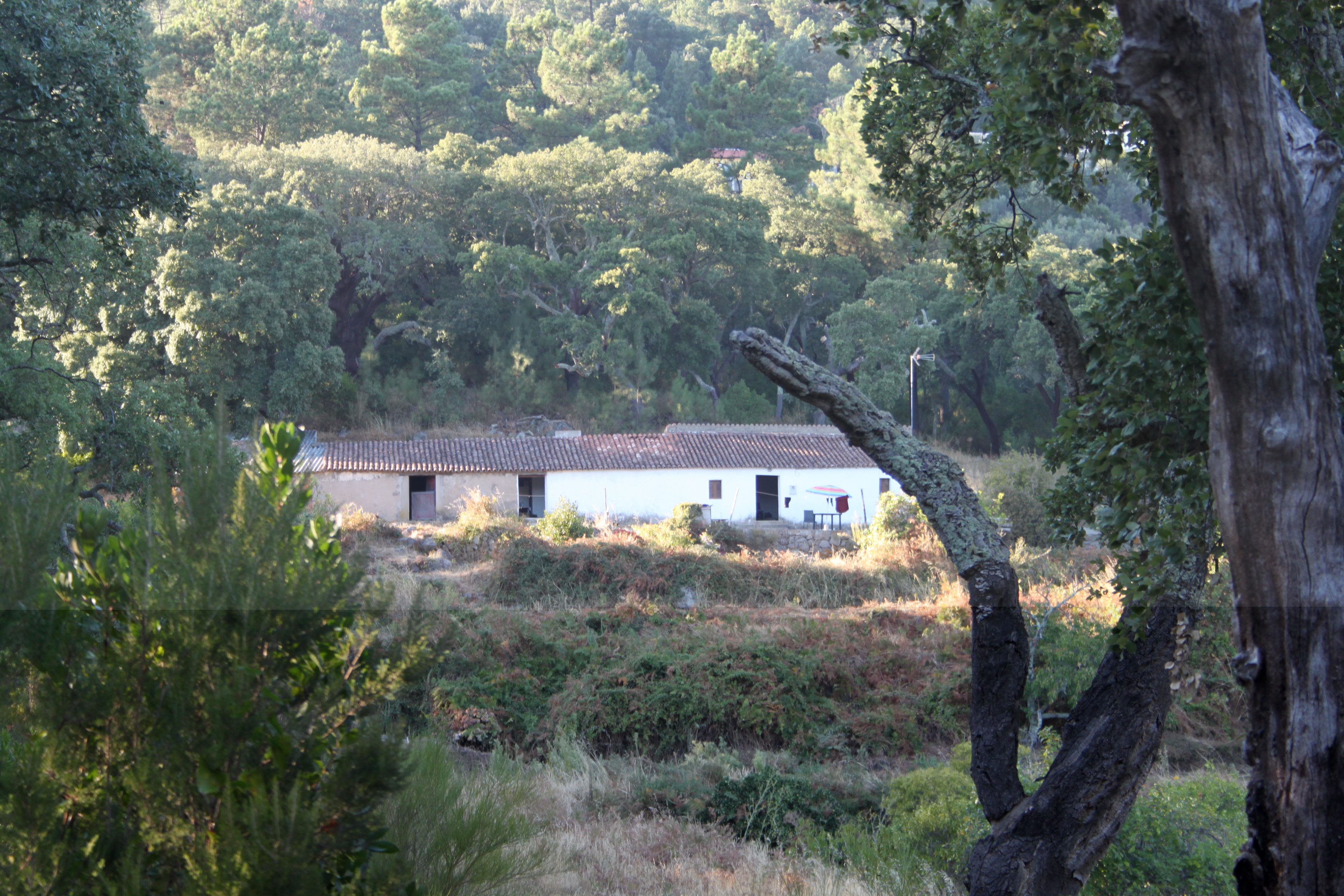
Food Security Begins Beneath Our Feet
Building a viable local food system requires more than goodwill — it requires infrastructure, coordination and a shared vision for Monchique's agricultural future.
Personal essays on food, health and regenerative farming in the Serra de Monchique — written as we go.
Building a viable local food system requires more than goodwill — it requires infrastructure, coordination and a shared vision for Monchique's agricultural future.
Is Monchique a small-scale example of what happens when we neglect the land beneath us?
Rising fuel and fertiliser costs, the absence of local markets, and inadequate processing infrastructure explain why land in Monchique is abandoned — and what it would take to bring it back.
The scale and frequency of Javali damage affects almost every part of what we are trying to achieve — and a new Government proposal raises questions that must be answered before any scheme begins.
Why I began questioning our food — and how family, loss and tired soil led to a different way of farming.
ASF is not present in Portugal, yet it is a risk worth understanding — not to create alarm, but to ask what we can reasonably do to reduce it.
Javali rooting has damaged our terraces and exposed the soil we are trying to restore. Beyond population control, there are simple things landowners can do themselves — starting with picking up the figs.
From clearing to cycling: how ten years of farming in the Serra de Monchique changed the way we think about machinery, biomass, and the resources the land produces.
The damage is visible. The science is clear. Portugal has a plan. The question is whether recognition is being translated into results on the ground.
Rewilding is often discussed in abstract terms. Here is what it means for one abandoned hillside in the Algarve.
What regenerative farming means for the specific conditions of Serra de Monchique — thin soils, summer drought, wildfire risk.
How one power cut changed the way we think about resilience, energy and self-sufficiency
Learning to Steward Monchique
We did not come to Monchique with answers.
We came here to live.
Over the years that followed, we found ourselves becoming increasingly connected to the land around us — its soils, water, trees, animals, seasons and, inevitably, its fires.
Much of what we have learned has not come from textbooks or formal education. It has come from observation, agricultural experience, mistakes, conversations, necessity and simply spending years working outside.
And gradually we began asking questions that extended beyond the boundaries of our own farm.
And perhaps most importantly: what can ordinary landowners actually do about it?
These questions eventually led us towards what we now call the Monchique Stewardship System.
But before explaining that, there is something more important we should say.
When we came to Monchique, we arrived as outsiders. We brought different experiences, different ideas and, initially, very little understanding of what it truly meant to live and work in these mountains.
What we found was a community that welcomed us.
Over the years, the kindness, patience, knowledge and friendship of the people around us have allowed us not simply to live here, but to become part of a place that we now hold very dear.
Monchique has given us the space to flourish, to learn and to grow.
Much of what we understand about this landscape has come not only from working the land ourselves, but from conversations, friendships, observations and knowledge generously shared by people who knew these mountains long before we did.
We remain newcomers compared with families whose roots here extend through generations, and we should never forget that.
Perhaps that is also why we feel such a responsibility towards the future of this place.
The Stewardship System is not an attempt to tell Monchique what it should become. It is our attempt to give something back to a community and landscape that have given so much to us.
We hope to contribute what we have learned while continuing to listen to and learn from the people around us.
We came here looking for a place to live. Somewhere along the way, Monchique became home.
We are not academics. We are not foresters, economists, sociologists or policymakers.
We do not pretend to understand all the forces that have shaped Monchique, and we certainly do not claim to possess the solution to its problems.
Our perspective is inevitably limited. It has largely been formed with boots on the ground — working with soil, water, vegetation, animals and machinery and dealing with the practical realities of maintaining land in these mountains.
Only later did we begin comparing some of our observations with academic research and public policy concerning Monchique and the wider Portuguese landscape.
What we found surprised us.
The language was different. The methods were different. The depth of research was certainly different.
But many of the underlying conclusions and questions were remarkably familiar.
Researchers were discussing rural depopulation, ageing, agricultural abandonment, wildfire vulnerability, landscape management, economic viability and community participation.
We had approached many of those same subjects from the other direction — simply by asking ourselves why the landscape around us was changing and what might realistically be done about it.
That does not turn our observations into scientific evidence. Nor does it prove that we are right. It simply gives us confidence that these are questions worth continuing to ask.
Perhaps the most important principle behind the Stewardship System is therefore not an agricultural technique at all.
It is humility.
We are learning. We will get things wrong. Ideas that appear sensible today may prove ineffective tomorrow. Something that works beautifully on one property may fail completely on another. And when evidence contradicts something we believe, it is our belief that must be reconsidered.
The Stewardship System must therefore never become fixed doctrine. Its method should be:
Observe. Understand. Question. Prioritise. Try. Measure. Learn. Adapt.
We should apply that principle not only to the land, but to the Stewardship System itself.
There is, however, one responsibility about which we feel strongly.
For however long land is under our control, we are its temporary guardians. We did not create its soils. We did not create its springs, valleys, forests or biodiversity. And ultimately, none of it truly belongs to us forever.
Our responsibility is to leave those things in better condition than we found them.
For us, that begins with soil and water.
Healthy soil is not simply something in which crops grow. It is living infrastructure.
So although our ambitions may extend beyond our property boundaries, our first responsibility remains very close to home: look after the soil beneath our own feet.
There is a saying commonly attributed to Hippocrates suggesting that before healing someone, we should ask whether they are prepared to give up the things that made them sick. The attribution itself is uncertain, but the principle is worth considering.
Before prescribing treatment, understand the causes.
That seems equally relevant to landscapes.
If land is being abandoned, simply clearing it does not answer why it became abandoned. If younger people do not see a future in agriculture or land management, telling them they should return to the land achieves very little. If local production cannot compete economically with large-scale supply chains, asking farmers simply to work harder is not an answer. If people value convenience, condemning convenience will not change their behaviour.
Before deciding what Monchique needs, perhaps we should first understand what is preventing the landscape and its communities from thriving already.
We also need to be careful with the word stewardship. It is our terminology. We should not presume that Monchique wants a 'stewarded landscape' simply because we believe it would be beneficial. Nor should we present the Stewardship System as the way forward. It is a possible way forward.
If we believe stewardship has value, our responsibility is to demonstrate that value.
These questions should be tested rather than preached.
A landscape cannot survive indefinitely on goodwill.
People need livelihoods. Young people need opportunities. Families need incomes. Landowners need some reason to invest their time, money and physical effort into managing their properties.
If the easier and more secure future always lies somewhere else, we should not be surprised when younger generations leave.
So our vision for Monchique is not simply a greener landscape.
It is a living landscape.
If we want the next generation to remain in Monchique, there must be something worth remaining for.
One of Monchique's great strengths is the extraordinary variety of people who have chosen to make these mountains their home.
Alongside families whose connection with the land reaches back generations is an international community bringing experiences and ideas from many different countries and cultures.
Within that community there is considerable interest in permaculture, ecological living, organic production, natural building, food growing and alternative approaches to land management.
We want to reach out to them too. Not because any one philosophy contains all the answers — it does not.
We need all of them.
The Stewardship System should not become another tribe defending its particular philosophy. It should be a place where useful ideas can meet.
This distinction matters deeply to us.
We are relatively recent arrivals compared with families who have lived here for generations. It would be extraordinarily presumptuous to arrive and tell those communities how Monchique should be managed.
That is not our intention.
We want to listen. We want to learn. We want to share what we discover. We want our assumptions challenged. We want to work alongside people already doing important work here.
And where organisations, researchers, farmers, permaculture practitioners, foresters or local residents possess knowledge greater than ours, we want to learn from them.
Our contribution can be practical: what happens when ideas actually meet the land?
This is where Raízes da Montanha becomes important. It is not intended to become a monument to the Stewardship System.
It is our classroom.
We can establish where we started. We can photograph it. Measure what we reasonably can. Record what we spend. Explain why we make particular decisions. Try different approaches. Watch what happens. And share the results.
When something succeeds, we can show it. When something fails, we should show that too.
Failure honestly recorded may be every bit as useful to another landowner as success.
Over time, perhaps those experiences can provide some of the practical meat on the bones that an individual landowner needs when standing at the entrance to an overgrown property wondering: Where do I start?
That is ultimately what we hope the Monchique Stewardship System might become.
Rather, a practical framework that helps individual landowners understand their land, identify their priorities and develop their own Land Stewardship Plan.
We love this place. That is ultimately why we care.
We would like to see a Monchique whose soils are improving rather than degrading.
Those ambitions are enormous. We certainly do not have the answers necessary to achieve them.
But perhaps we can contribute something.
The Monchique Stewardship System therefore begins not with an answer, but with a question:
“How can all of us who care about this landscape help create a thriving, productive and resilient Monchique for those who will inherit it?”
We do not know the answer. But we would very much like to help find it.
The Monchique Stewardship System has developed from more than ten years of living, farming, observing and learning in the Serra de Monchique.
It is not intended to be a rigid agricultural prescription, nor do we claim to have discovered all the answers. Quite the opposite. One of the most important lessons the land has taught us is that there will always be more to learn.
The System provides us with a framework for making decisions.
“Every decision either strengthens or weakens the living system. There is no truly neutral decision.”
Water, soil, plants, animals, microorganisms, wildlife and people are not separate components. They are interconnected parts of one living landscape. When one relationship is weakened, the consequences can spread throughout the system. When those relationships are strengthened, the landscape becomes increasingly resilient.
The practices described in this Guide are those we use, are developing, or intend to trial at Quinta Picapau and Raízes da Montanha. They will continue to evolve as our understanding grows. This is therefore a living Practice Guide.
Living Systems Stewardship is the practice of understanding, restoring and strengthening the interconnected relationships that sustain life. It recognises that water, soil, sunlight, carbon, plants, animals, microorganisms and people do not exist as separate parts, but as one living system. The role of the steward is not to dominate these relationships, but to observe them, nurture them and leave them stronger for future generations.
Unlike conventional land management, which often measures success by what is extracted from the land, Living Systems Stewardship measures success by what is returned to it.
Every decision is guided by a simple question:
Will this action improve the health, resilience and regenerative capacity of the whole living system?
If the answer is yes, it strengthens stewardship.
If the answer is no, it should be questioned.
We believe that life is sustained through relationships.
Water feeds soil.
Soil supports microorganisms.
Microorganisms nourish plants.
Plants capture sunlight.
Animals recycle nutrients.
Trees moderate climate.
People care for the landscape.
Each depends upon the others.
Nothing exists in isolation.
The health of the whole depends upon the health of every part. The steward therefore manages relationships rather than individual components. Healthy landscapes emerge when these relationships are strengthened. Degraded landscapes emerge when they are broken.
Everything else — food production, forestry, compost, biochar, grazing, wildfire resilience and community renewal — flows from these five foundations.
the bloodstream of the landscape
the digestive and immune system of the landscape
the intelligence and resilience of the landscape
the conscious stewards of the landscape
the element through which regeneration unfolds
A steward is not an owner of nature.
A steward is a temporary guardian of a living inheritance.
We recognise that the landscapes we care for have been shaped by countless generations before us and will continue long after we are gone.
Our responsibility is to pass them forward in better condition than we received them.
Stewardship therefore demands humility. It requires observation before intervention. Understanding before action. Long-term thinking before short-term gain. The steward works with natural processes rather than attempting to replace them.
Everything is connected. No decision affects only one part of the landscape.
Water is the first foundation of resilience. Every drop retained within the landscape supports life.
Living soil is the engine of regeneration. Healthy soil biology underpins productive ecosystems.
Sunlight is the primary source of energy. Every green leaf captures energy that drives the living system.
Carbon builds living landscapes. Carbon stored in soils and vegetation strengthens fertility, biodiversity and water-holding capacity.
Diversity creates stability. The greater the diversity of life, the greater the resilience of the system.
Animals are ecological partners. When thoughtfully managed, they recycle nutrients, manage vegetation and complete natural cycles.
People are part of nature. Human wellbeing and ecological wellbeing cannot be separated.
Waste does not exist in living systems. Every organic material has the potential to nourish new life.
Resilience is the true measure of success. A healthy system becomes more capable of adapting to drought, wildfire, floods, pests and uncertainty.
Living Systems Stewardship extends beyond property boundaries. Water flows across neighbouring land. Wildlife moves between habitats. Fire ignores fences. Knowledge is shared through communities. For this reason, stewardship is not only a personal responsibility but a collective one. Healthy landscapes depend upon cooperation, shared learning and active care.
Living Systems Stewardship is not a farming method. It is not a conservation programme. It is not a fixed set of techniques. It is a way of seeing the world. It asks us to recognise that every landscape is a living community whose health depends upon countless visible and invisible relationships. The task of the steward is to understand those relationships, strengthen them and allow nature's own processes to perform the work they have refined over millions of years.
We do not seek to control nature.
We seek to understand it.
We do not measure success by what we take from the land.
We measure success by the strength of the living systems we leave behind.
Each part can be read independently or as a chapter in the complete guide. Together they set out the practice guidelines we have adopted at Raízes da Montanha and Quinta Picapau — drawn from our own experience in the Serra de Monchique, and offered as a starting point in the absence of any comparable guide for this landscape. We do not claim to have all the answers.
Stewardship begins not with tools or techniques, but with an honest assessment of what we can actually give to the land — and what it genuinely needs from us.
A property boundary exists on a map. A living system does not recognise it. Learning to read the landscape — its water, soil, vegetation, animals and wider context — is the foundation of everything that follows.
Without water nothing else thrives. Our objective is simple: slow it, spread it, sink it, store it. The soil itself can become one of our greatest reservoirs.
Soil is not an inert material requiring repeated feeding. It is a living ecosystem. Our aim is to create conditions in which the living soil can increasingly support the crop itself.
Most of the living system that sustains agriculture exists out of sight. Carbon, fungi, bacteria and earthworms form a community beneath our feet that no purchased input can replicate.
Bare soil is vulnerable soil. Cover crops, minimal disturbance and intelligent nutrient cycling are how we keep the land covered, rooted and biologically active for as much of the year as the climate allows.
Trees, orchards, shrubs and agroforestry layers are not separate enterprises. They are a whole system. The highest expression of agriculture may be a productive landscape that increasingly behaves like a healthy ecosystem.
Every leaf is a solar collector. Biomass is stored sunlight waiting for a purpose. In Monchique, the challenge is not simply to produce more vegetation — it is to produce, cycle and manage biomass intelligently.
Livestock are not production units. They are ecological participants. The ecological value comes entirely from management — the right animal, in the right place, at the right time, for the right purpose.
We no longer see wildfire solely as an emergency beginning when smoke appears on the horizon. Fire begins long before the spark. A wildfire-resilient landscape is created through thousands of decisions made during the months and years before fire arrives.
Eucalyptus is frequently presented as the principal explanation for catastrophic wildfire in Portugal. The reality is more complex. Our question at Raízes da Montanha is: how can an inherited eucalyptus stand be progressively managed so that it becomes an asset rather than a liability?
A landscape that cannot support the people who care for it will ultimately be at risk of abandonment. The question is not how much we can extract — but how this landscape can support people while becoming healthier every year.
No farm exists in isolation. Water, wildlife and fire all move between properties. The resilience of Monchique cannot be achieved one isolated quinta at a time — stewardship must ultimately become collaborative.
We use a wider definition of success than yield and financial return alone. Scientific measurement and experienced observation should complement one another. Ultimately we return to one simple question: Is this landscape healthier than it was before?
The complete guide in one long readable page — from introduction to stewardship principle.
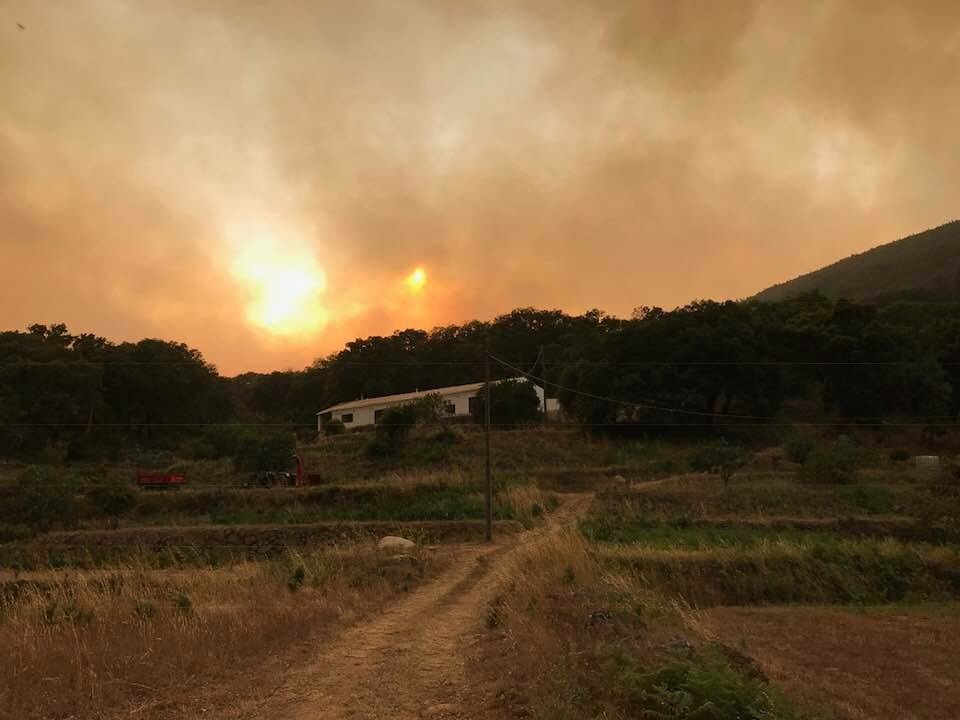
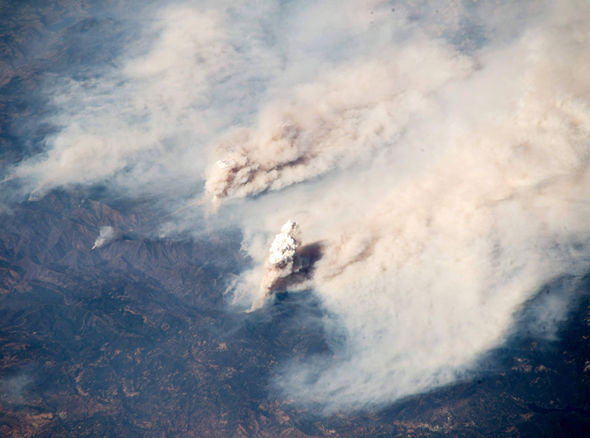
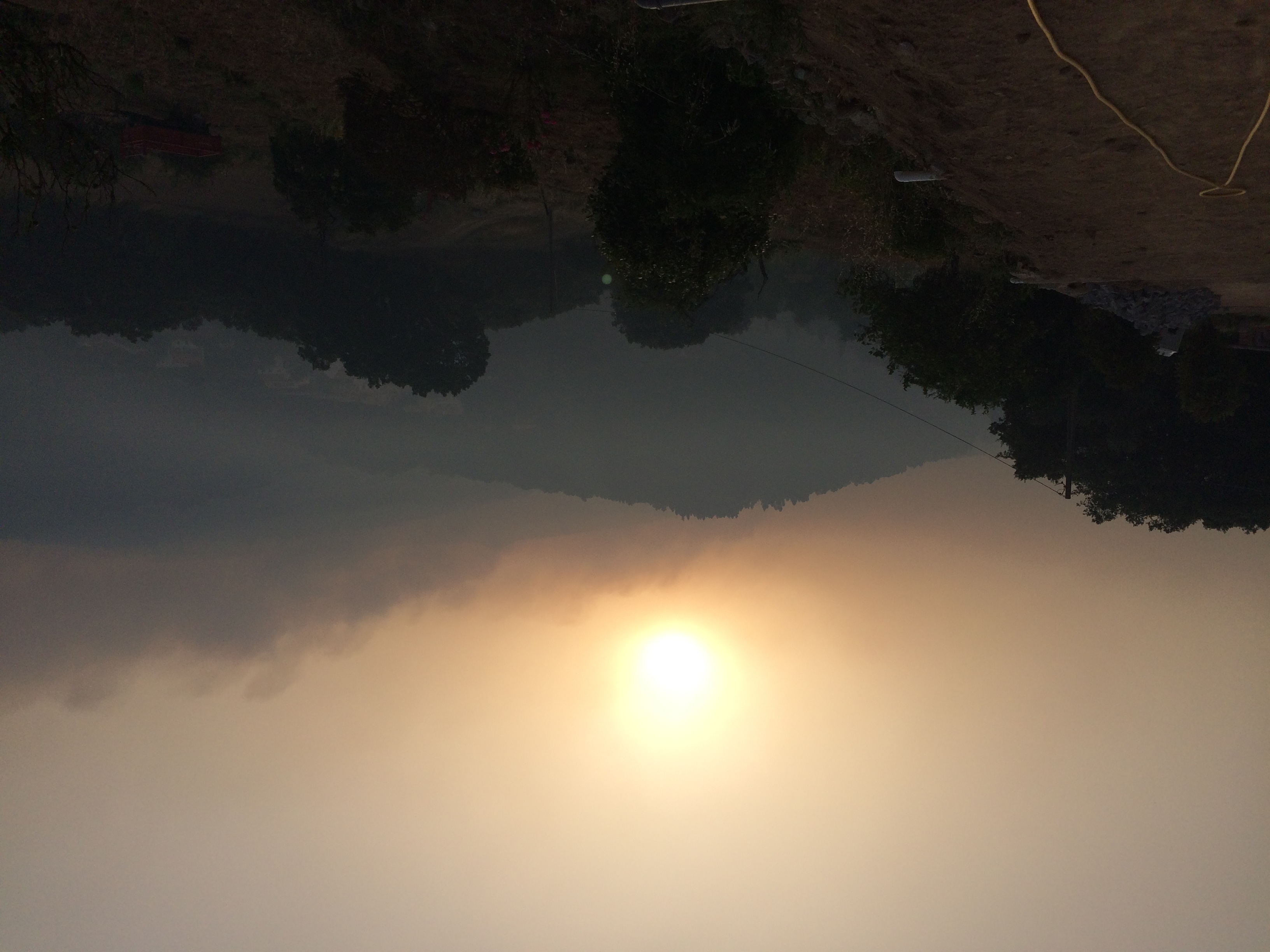
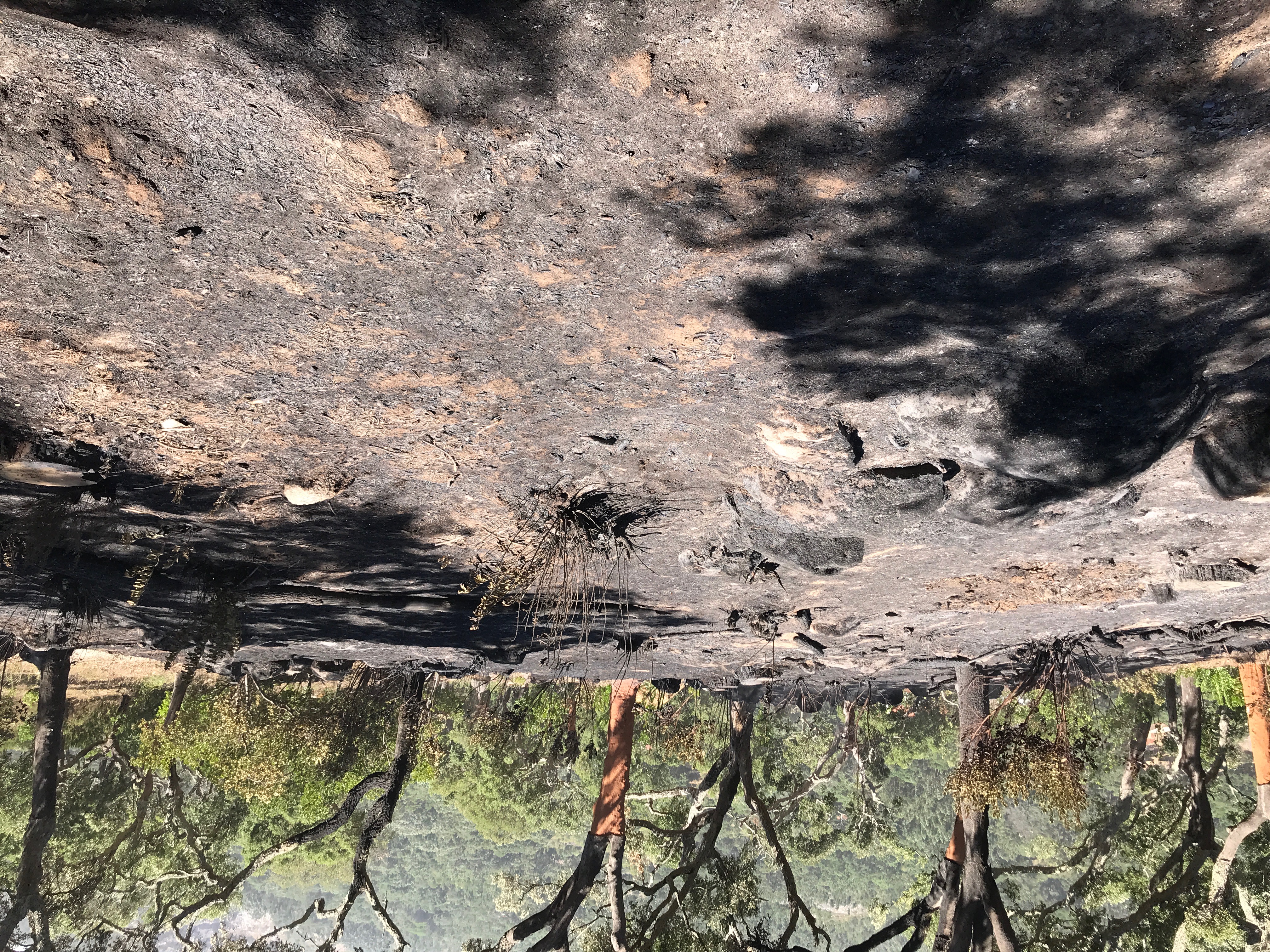
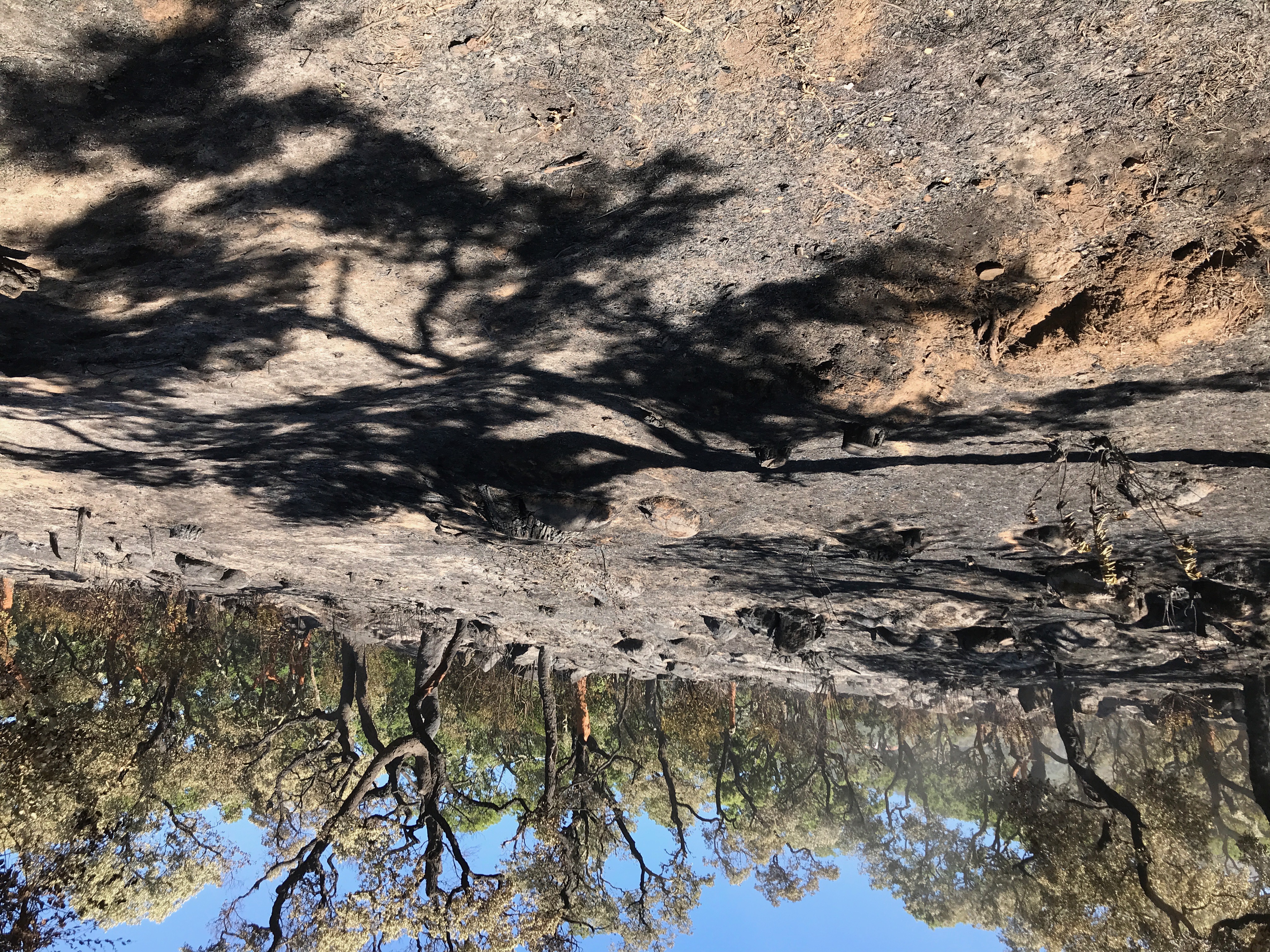
The Serra de Monchique has been devastated by wildfire in recent years — most catastrophically in 2018. The pattern is familiar across Portugal: abandoned scrubland, dense flammable vegetation, and nobody on the land to slow the fire or sound the alarm.
We don't treat wildfire resilience as a separate goal. It is an outcome of productive, well-managed land — and our farms are designed to demonstrate that directly. The same practices that build soil and produce food are the ones that reduce fire risk.
“The 2018 fire burned nearly 27,000 hectares in Monchique. The mosaic of managed farms and orchards that once characterised this landscape largely stopped burning where it remained.”
Animals will clear combustible undergrowth, build soil organic matter and create natural firebreaks — productive work that the land rewards.
Swales, ponds and water management will slow rainfall, recharge springs and keep the land moist through summer — the single most important factor in fire behaviour.
Mixed food forests and native tree mixes burn far less readily than eucalyptus and pine monocultures — and produce food, timber and habitat.
Someone working the land daily is an early warning system. Abandoned land has no one watching.
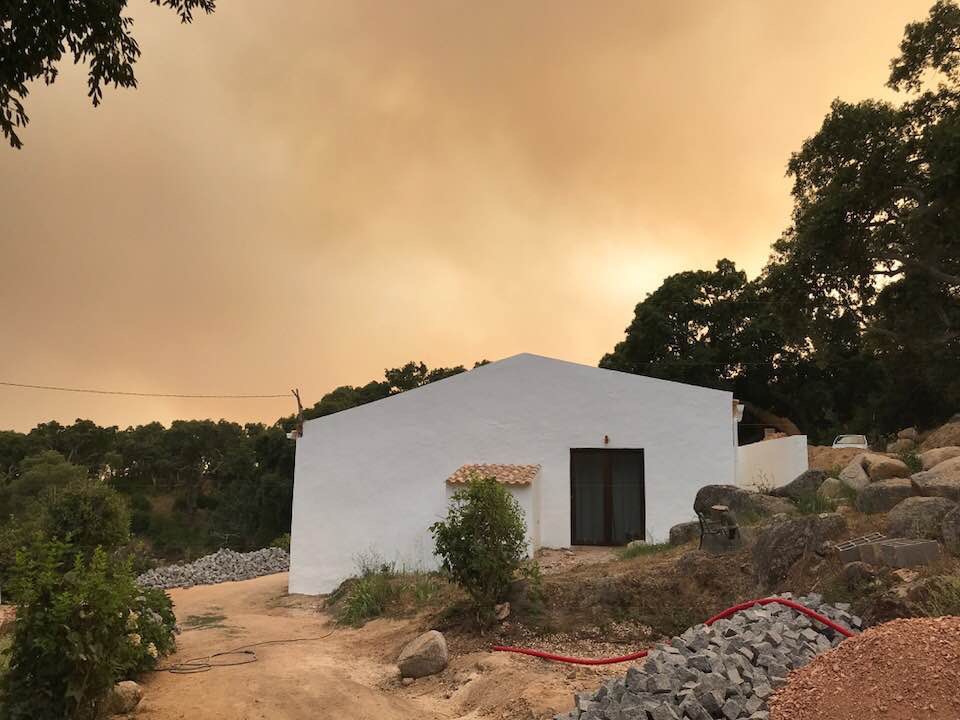
Thick smoke blotted out the sun for days, making breathing difficult and casting an eerie orange light across the landscape. The third image shows the scale of the fires as seen from space — nearly 27,000 hectares burned in Monchique alone.
Raízes da Montanha is a young project. We are still in the early stages of establishing the farms and developing the Stewardship System on the ground. In time, we intend for these farms to be places where people can come and see, touch and test what this approach looks like in practice. That is not something we are offering yet — but it is very much part of where we are heading.
Guided walks through the farms focused on specific topics — water management, agroforestry design, soil health, fire-resilient landscape planning. Suitable for small groups. Planned for the future as the farms develop.
Time on the farm doing real work alongside us — hands in the soil, composting, planting, water management. Understanding the system from the inside. Something we hope to offer once the foundations are properly in place.
Structured sessions on specific topics — biochar making, water harvesting design, regenerative grazing planning, and more. Designed for farmers, land managers and serious learners. These will come in time as our demonstration sites mature.
We are not taking bookings yet. The project is new, the land is being established, and we want to offer something of real value when the time is right. If this interests you, register below and we will be in touch when visits and courses open up.
Register Your Interest →We document our work as we go — sharing what works, what doesn't, and what surprises us. These are a few things we have been thinking about.
Receive occasional updates from the farms — no spam, just real learning shared honestly.
Whether you have land to restore, want to visit the farms, or simply want to follow along as the system develops — reach out. We read every message and reply to all of them.