Living with Javali: Simple Things Landowners Can Do
Javali rooting has damaged our terraces and exposed the soil we are trying to restore. Beyond population control, there are simple things landowners can do themselves — starting with picking up the figs.
At Raízes da Montanha we are experiencing significant problems with Javali — wild boar (Sus scrofa).
Their rooting has disturbed extensive areas of ground, damaged terraces and exposed soil that we are trying to protect and restore. Following heavy summer rain, when previously hard ground becomes soft, the extent of that disturbance can increase very quickly.
It is easy, when confronted with this sort of damage, to concentrate entirely on the Javali themselves.
But there is another question worth asking:
What are we doing, individually and collectively, that makes the landscape attractive to them?
This does not remove the need for proper population management. Nor does it place responsibility for increasing Javali numbers upon individual landowners. It simply recognises that there are practical things we can do ourselves.
Start with something as simple as a fig
At this time of year our fig trees are producing heavily. Very ripe figs are dropping continuously and accumulating beneath the trees. To us, they are fallen fruit, but to a Javali, they are food. More importantly, they are a predictable food source. If a Javali discovers ripe figs beneath a particular tree tonight and receives a substantial food reward, there is every reason for it to investigate the same place tomorrow night. Without intending to, we can teach Javali where dinner is served. The immediate response costs almost nothing:
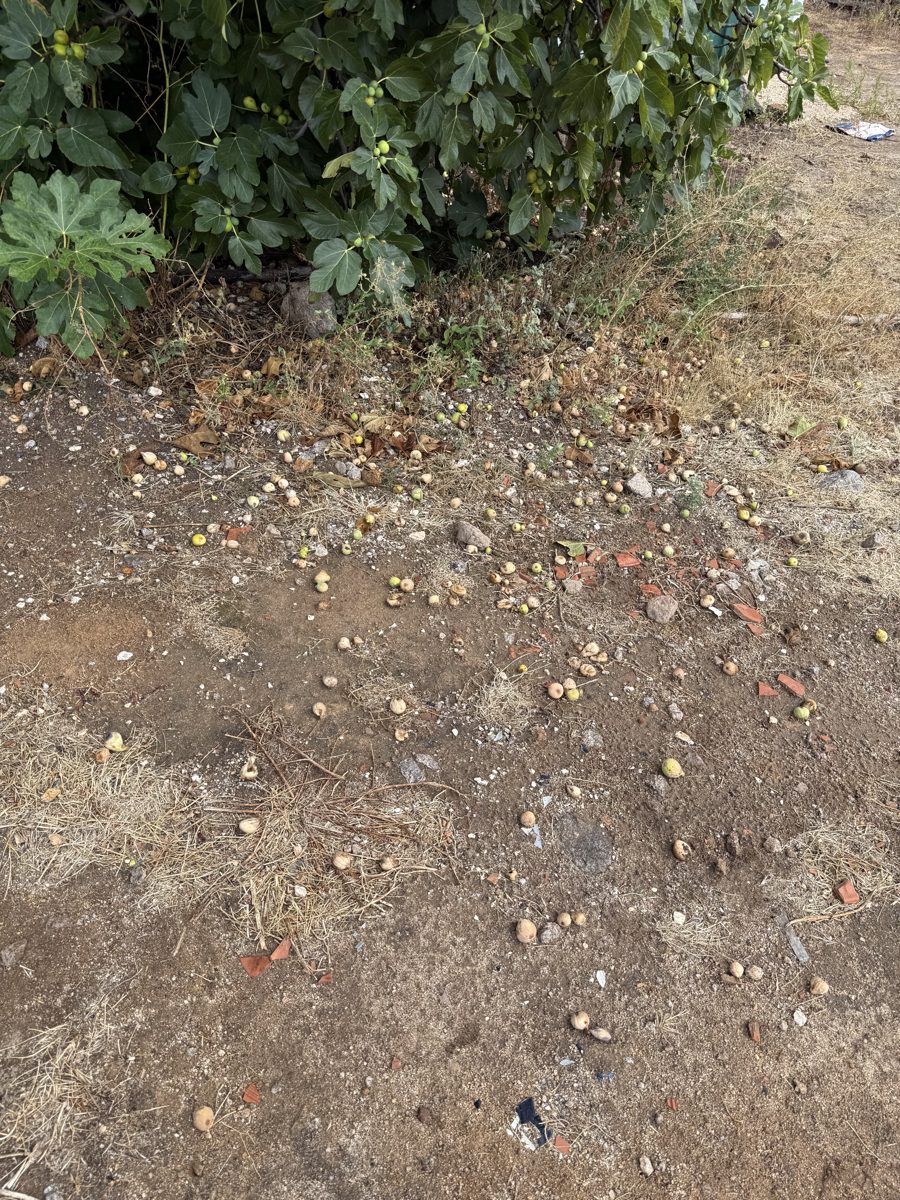
Pick up the figs.
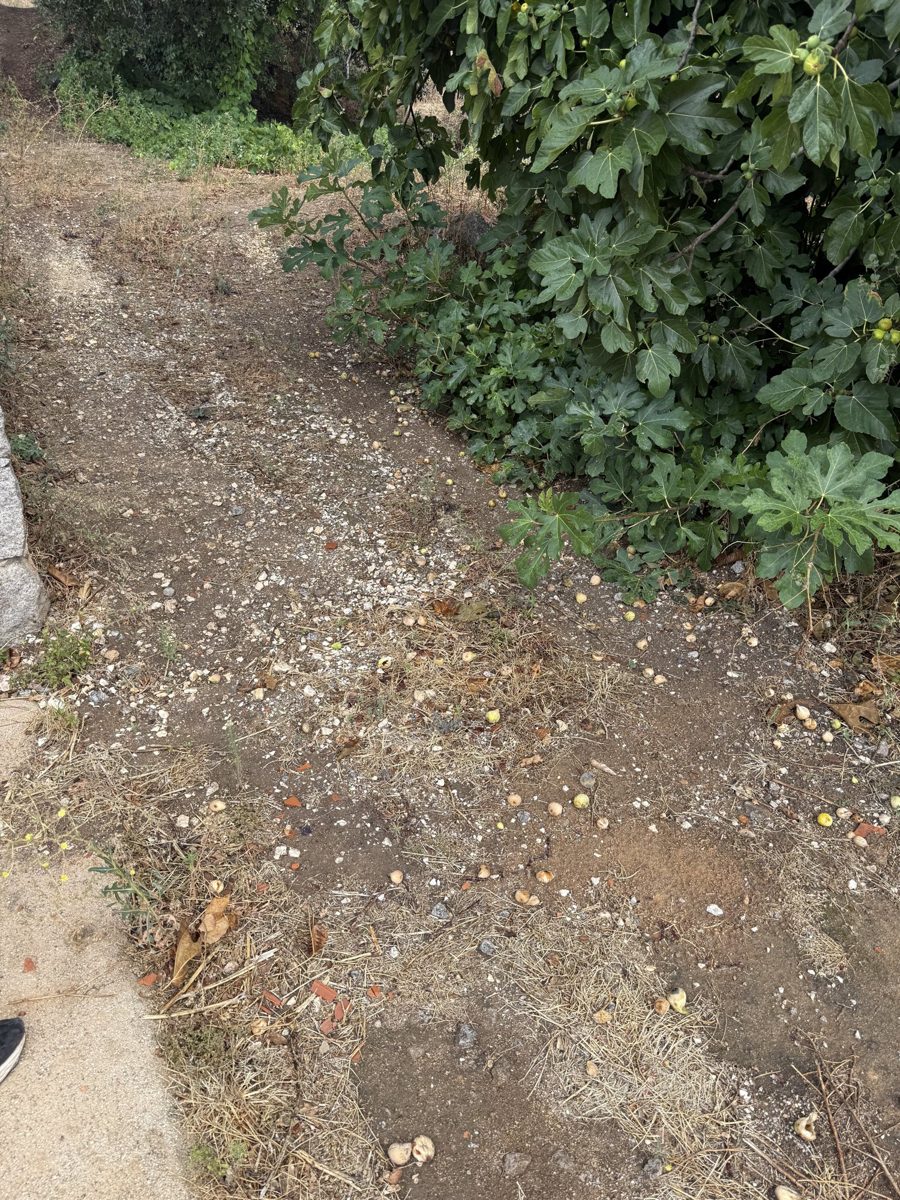
That will not solve Monchique's wider Javali problem. It will not reduce the population. It simply removes one reason for them to visit our land. The same principle applies to many other things.
Remove the attractions we can control
Figs are only one example; depending upon the property, Javali may find fallen grapes, olives, carob, apples, pears and other fruits and nuts. Harvest fruit promptly where practical and collect significant quantities of fallen fruit, particularly during periods of heavy fruit fall. Don't simply move it to an accessible compost heap elsewhere on the property — you will only give them the excuse to destroy your compost heap.
Feed for pigs, chickens, goats and other livestock should be securely stored. Significant spillages around feeders should be cleaned up, and uneaten feed should not routinely remain accessible overnight. Food waste, rubbish and food-rich compost should similarly be secured.
Water should also be considered. Springs, leaking irrigation, livestock troughs and ponds can influence where animals travel, especially during hot summer periods. Javali will remain within short distances of a water source. The objective isn't to remove every natural resource from our land. It is to understand what is attracting the animals and then decide which attractions we can reasonably manage.
Abandoned land changes the equation
There is a much larger issue in Monchique: land abandonment. Across the landscape there are terraces and former agricultural areas that are no longer actively managed. Many still contain mature fig, olive, carob and other productive trees. The trees haven't stopped producing simply because people have stopped farming them.
An abandoned fig orchard could potentially produce hundreds of kilograms of fruit during a season without a single fig being harvested.
It can be a seasonal food source.
Abandoned land may also develop dense vegetation and experience relatively little regular human disturbance. Food, cover and security can therefore occur together.
This doesn't mean that owners of abandoned land should be blamed for the Javali problem. Rural abandonment has complicated economic, demographic and regulatory causes, but it does mean that land abandonment and Javali management cannot be considered entirely separate issues.
The damage may occur between the food and the shelter
There is another part of this problem which is easily overlooked. Javali don't necessarily spend the day where they feed at night. One property might provide dense, undisturbed daytime cover. Another might contain abandoned fig trees providing abundant seasonal food. Water might be somewhere else entirely. The animals have to travel between them.
And Javali do not recognise property boundaries.
Along the way they may root the soil, disturb terraces, damage crops, push beneath fences or cross recently prepared and seeded ground.
The place where Javali cause damage is not necessarily the reason they are there.
Learn their routes
Rather than simply recording that Javali have visited, we should start looking for patterns. Where are they entering? Where are they leaving? Which tracks are repeatedly used? Where are fences being pushed underneath? Where are the watercourses, gullies and easy crossings? Where is dense daytime cover? Where are the seasonal food sources?
Once we begin answering these questions, isolated incidents can become a picture of Javali movement through the landscape.
Photographs, dates, locations, recent weather and observations of fresh rooting can all contribute. This is one reason we have started systematically documenting Javali activity at Raízes da Montanha.
Heavy rain matters
Our observations are also demonstrating the importance of weather. After intensive nighttime rain, previously hard summer soil becomes considerably softer. Javali can then disturb ground very rapidly. Heavy rain may also create vulnerabilities beneath fences, wash vegetation against electric conductors or alter established routes. It therefore makes sense to inspect vulnerable areas following significant rainfall. Prevention should respond to conditions rather than remain exactly the same throughout the year.
Protect what matters most
It may not be practical to exclude Javali completely from a large rural property.
Concentrate protection where damage would be most serious: vegetable gardens, newly seeded terraces, orchards, livestock areas and valuable crops.
Electric fencing can form an important part of that protection, but it must be correctly installed and maintained. Low conductors are particularly important for Javali. Vegetation must be kept away from electric wires, voltage should be checked regularly, and gates, gullies, watercourses and changes in ground level deserve particular attention.
A long, excellent fence can potentially be defeated by one weak crossing.
And no fence should be regarded as completely Javali-proof.
Don't depend upon gadgets
Lights, smells, noises and various commercial repellents may temporarily disturb Javali.
The difficulty is habituation. An intelligent animal can eventually learn that a flashing light or unfamiliar smell poses no actual threat. Deterrents may therefore have a place, but they should not replace the fundamentals:
Remove attractants. Understand movement. Protect vulnerable areas. Maintain effective barriers.
And then talk to the neighbours
Talk to the people around you.
If Javali cross several properties travelling between shelter, water and food, managing them independently has obvious limitations. One landowner strengthens a fence and diverts the animals onto another property. That neighbour responds by doing the same.
We may simply move the problem around the landscape.
Instead, neighbouring landowners could share relatively simple information.
Where are Javali entering? Where are they leaving? At approximately what time? Which routes are repeatedly being used? Where is significant fruit falling? Where are they finding water? Where are they sheltering?
Even five neighbouring landowners sharing these observations could begin to reveal something that none could easily see from their own property: the route through the landscape.
Coordinate the simple things
Once neighbours start communicating, preventative measures can also become coordinated. If several properties have fruit trees, fallen fruit can be managed during the same high-risk period. Known crossings can be monitored. Electric fencing can be planned so that obvious gaps aren't simply transferring animals from one property to another.
Neighbours can alert each other when a group is moving through.
And if one property contains an area that is particularly attractive to Javali, everyone can better understand how that attraction may influence surrounding land. Instead of five landowners separately saying:
“Javali damaged my property.”
they might eventually be able to say:
“A group of Javali is regularly moving through this part of the landscape along this route, apparently travelling between this area of cover, this water source and these seasonal feeding areas.”
That is considerably more useful information.
It is also far more useful evidence to present to authorities when intervention beyond the capacity of individual landowners becomes necessary.
Prevention is not population control
None of this should distract from the wider question of Javali numbers.
Picking up figs will not control a Javali population.
Neither will an electric fence.
Removing attractants and improving barriers can reduce the vulnerability of an individual property, but effective population management is a different issue requiring cooperation between landowners, hunters, municipalities and the relevant authorities.
We need both.
We should do the things that are reasonably within our control while continuing to address the wider population problem.
Land management does not stop at the boundary
A neglected orchard on one property can influence what happens on another. Dense vegetation can provide shelter for animals that feed somewhere else. A water source can influence movement across several farms.
Equally, good management can have benefits beyond the property where it occurs.
Bringing abandoned terraces back into management, harvesting fruit, controlling excessive vegetation, maintaining access and increasing regular human presence may contribute not only to agriculture but also to fire resilience and wildlife management.
This is why neighbour-to-neighbour cooperation should become part of land stewardship in Monchique.
Start tomorrow morning
Before spending money on increasingly sophisticated ways of keeping Javali out, walk around the property and try to see it from their perspective.
Ask:
Where is the food? Where is the water? Where is the shelter? Where can they get through? Where are they coming from? Where are they going?
What reward would make them return tomorrow night?
Then ask one more question:
What are my neighbours seeing?
At Raízes da Montanha, one answer was lying directly beneath our fig trees.
Sometimes landscape-scale problems begin with very simple observations.
And sometimes better land stewardship begins with something as simple as picking up the figs — and talking to the neighbour over the fence.